https://www.politico.com/story/2017/10/26/trump-ed-gillespie-tweet-monuments-244205
The above is the link to the article.
These are the links to his tweets related to Confederate monuments.
Thursday, October 26, 2017


Kathleen Harnett-White and her article about Texas and secession in "Texas Republic" magazine is in the news. IMPORTANT UPDATE
Earlier this week I supplied Andrew Kaczynski the article that Kathleen Hartnett-White wrote for Texas Republic magazine about Texas being better off as an independent republic.
The article is online at this link:
http://www.cnn.com/2017/10/26/politics/kfile-hartnett-white-texas-independent-republic/index.html
You collect things and it sits on the shelf for years and years and you wonder if it will ever serve any purpose and 20 years later it does.
Do not confuse Texas Republic magazine with the Republic of Texas movement. Texas Republic was a publication of the Lynn Landrum Society. William Murchison did an interview for Southern Partisan magazine to introduce the magazine to its readers. It was a magazine for the right-wing in the Texas conservative establishment. In Texas the magazine wasn't fringe. Last issue was published in 1996.
The first issue was in dedicated to M.E. Bradford, a professor at the University of Dallas who spent his life trying to undermine civil rights in America. Bradford was the leading intellectual for the neo-Confederate movement and was a major figure in getting it started.
I sent Kaczynski some writes I did on the magazine also.
It should not be surprising that at the 2016 Texas State Republican Party convention that the vote against secession was only 16 to 14. It should not be surprising that Boys State in Texas voted for secession.
IMPORTANT UPDATE:
You can read the article that Kathleen Hartnett White wrote for Texas Republic at this link.
https://www.documentcloud.org/documents/4118046-KHW.html
OTHER UPDATES:
The story of Kathleen Hartnett White's essay in Texas Republic magazine is beginning to get some traction in the media. These are some other sites carrying the story.
https://www.rawstory.com/2017/10/trump-environmental-pick-once-claimed-texas-would-be-better-off-if-the-state-seceded-to-avoid-regulations-report/
http://thehill.com/homenews/administration/357410-trump-environmental-nominee-texas-would-be-better-off-as-an
The article is online at this link:
http://www.cnn.com/2017/10/26/politics/kfile-hartnett-white-texas-independent-republic/index.html
You collect things and it sits on the shelf for years and years and you wonder if it will ever serve any purpose and 20 years later it does.
Do not confuse Texas Republic magazine with the Republic of Texas movement. Texas Republic was a publication of the Lynn Landrum Society. William Murchison did an interview for Southern Partisan magazine to introduce the magazine to its readers. It was a magazine for the right-wing in the Texas conservative establishment. In Texas the magazine wasn't fringe. Last issue was published in 1996.
The first issue was in dedicated to M.E. Bradford, a professor at the University of Dallas who spent his life trying to undermine civil rights in America. Bradford was the leading intellectual for the neo-Confederate movement and was a major figure in getting it started.
I sent Kaczynski some writes I did on the magazine also.
It should not be surprising that at the 2016 Texas State Republican Party convention that the vote against secession was only 16 to 14. It should not be surprising that Boys State in Texas voted for secession.
IMPORTANT UPDATE:
You can read the article that Kathleen Hartnett White wrote for Texas Republic at this link.
https://www.documentcloud.org/documents/4118046-KHW.html
OTHER UPDATES:
The story of Kathleen Hartnett White's essay in Texas Republic magazine is beginning to get some traction in the media. These are some other sites carrying the story.
https://www.rawstory.com/2017/10/trump-environmental-pick-once-claimed-texas-would-be-better-off-if-the-state-seceded-to-avoid-regulations-report/
http://thehill.com/homenews/administration/357410-trump-environmental-nominee-texas-would-be-better-off-as-an
Letter to Dallas Mayor Mike Rawlings about the replica Robert E. Lee Mansion at Oaklawn Park
The replica of the Robert E. Lee Park wasn't even considered by the Task Force on Confederate Monuments.
An error here in the letter. Stratford Hall is the home of the Lees of Virginia and Arlington Hall is the home of Robert E. Lee. Lee was born in Stratford Hall.
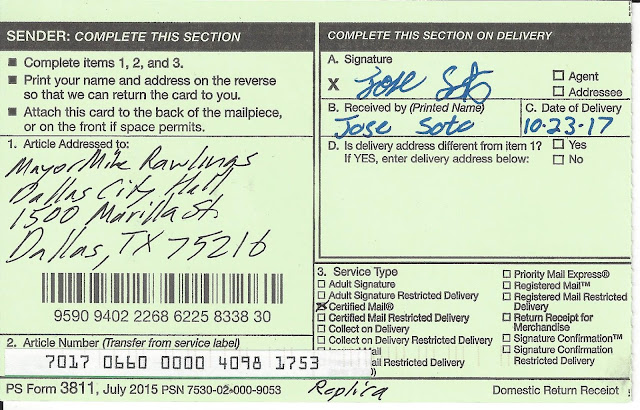
This letter was sent certified to Rawlings along with copies to all 14 Dallas city council members.
This is the account which I enclosed with the mailing.
An error here in the letter. Stratford Hall is the home of the Lees of Virginia and Arlington Hall is the home of Robert E. Lee. Lee was born in Stratford Hall.
This letter was sent certified to Rawlings along with copies to all 14 Dallas city council members.

October
15, 2017
Edward
H. Sebesta
edwardsebesta@gmail.com
Mayor
Mike Rawlings
City of
Dallas
Mayor and
City Council City of Dallas
1500
Marilla St.
Dallas,
TX 75201
Dear Hon.
Rawlings:
I regret
to see that the Task Force on Confederate Monuments didn’t include the
one-third replica of Lee’s plantation house, Stratford, at Oak Lawn Park in its
deliberation.
The
replica Stratford was understood to be an important part of promoting the idea
that Robert E. Lee was a hero by the Dallas Southern Memorial Association
(DSMA).
The DSMA
in the forwards written by their presidents explain sometimes directly and
sometimes less directly that the purpose of Robert E. Lee Park was to oppose
the civil rights movement.
The
replica Stratford is not a plantation house in general but a specific
plantation house where slavery was practiced and the plantation house of Robert
E. Lee. It serves to normalize both Robert E. Lee and antebellum slavery in the
United States and excuse Robert E. Lee’s practice of slavery. I enclose an account of Lee having runaway
slaves punished, and how horrible the use of salt and brine in these
punishments were. These are the terrors in history than plantation weddings
ignore.
I see no
good reason why this wasn’t included in the agenda of the Task Force on
Confederate monuments. It is a Confederate monument. In fact it is worse than
Confederate statues since when it is used people are directly engaged in it.
I don’t
think the city of Dallas should be engaged directly or indirectly in the
plantation wedding business and this replica plantation house needs to be
addressed. It also should not be addressed as is done in some cases by having
some token African American cultural event.
Sincerely
Yours,
Edward
H. Sebesta
CC:
Office
|
Name
|
Address
|
Address
|
Mayor Pro Tem
|
Dwaine Caraway
|
Mayor and City Council
|
Dallas City Hall
|
Deputy Mayor Pro Tem
|
Adam Medrano
|
Mayor and City Council
|
Dallas City Hall
|
District 1 Council Member
|
Scott Griggs
|
Mayor and City Council
|
Dallas City Hall
|
District 3 Council Member
|
Casey Thomas II
|
Mayor and City Council
|
Dallas City Hall
|
District 5 Council Member
|
Rickey D. Callahan
|
Mayor and City Council
|
Dallas City Hall
|
District 6 Council Member
|
Omar Narvaez
|
Mayor and City Council
|
Dallas City Hall
|
District 7 Council Member
|
Kevin Felder
|
Mayor and City Council
|
Dallas City Hall
|
District 8 Council Member
|
Tennell Atkins
|
Mayor and City Council
|
Dallas City Hall
|
District 9 Council Member
|
Mark Clayton
|
Mayor and City Council
|
Dallas City Hall
|
District 10 Council Member
|
B. Adam McGough
|
Mayor and City Council
|
Dallas City Hall
|
District 11 Council Member
|
Lee Kleinman
|
Mayor and City Council
|
Dallas City Hall
|
District 12 Council Member
|
Sandy Greyson
|
Mayor and City Council
|
Dallas City Hall
|
District 13 Council Member
|
Jennifer Staubach Gates
|
Mayor and City Council
|
Dallas City Hall
|
District 14 Council Member
|
Philip T. Kingston
|
Mayor and City Council
|
Dallas City Hall
|
This is the account which I enclosed with the mailing.
Robert E.
Lee Has His Slaves Whipped and Brine Poured Into the Wounds
The following account if from the
book, “Slave Testimony: Two Centuries of Letters, Speeches, and Interviews, and
Autobiographies,” edited by John W. Blassingame. It is published by Louisiana
State University Press, Baton Rouge 70893.
[Page 467]
Newspaper and Magazine Interviews,
1864‑1938
WESLEY NORRIS
Interviewed, 1866(?), b. Virginia,
Enslaved: Virginia
It has frequently been represented
by the friends and admirers of Robert E. Lee, late an officer in the rebel
army, that, although a slaveholder, his treatment of his chattels was
invariably kind and humane. The subjoined statement, taken from the lips of one
of his former slaves, indicates the real character of the man:
"My name is Wesley Norris; I
was born a slave on the plantation of George Parke Custis; after the death of
Mr. Custis, Gen. Lee, who had been made executor of the estate, assumed control
of the slaves, in number about seventy; it was the general impression among the
slaves of Mr. Custis that on his death they should be forever free; in fact
this statement had been made to them by Mr. C. years before; at his death we
were informed by Gen. Lee that by the conditions of the will we must remain
slaves for five years; I remained with Gen. Lee for about seventeen months,
when my sister Mary, a cousin of ours, and I determined to run away, which we
did in the year 1859; we had already reached Westminster, in Maryland, on our
way to the North, when we were apprehended and thrown into prison, and Gen. Lee
notified of our arrest; we remained in prison fifteen days, when we were sent
back to Arlington; we were immediately taken before Gen. Lee, who demanded the
reason why we ran away; we frankly told him that we considered ourselves free;
he then told us he would teach us a lesson we never would forget; he then
ordered us to the barn, where, in his presence, we were tied firmly to posts by
a Mr. Gwin, our overseer, who was ordered by Gen. Lee to strip us to the waist
and give us fifty lashes each, excepting my sister, who received but twenty; we
were accordingly stripped to the skin by the overseer, who, however, had
sufficient humanity to decline whipping us; accordingly Dick Williams, a county
constable, was called in, who gave us the number of lashes ordered; Gen. Lee,
in the meantime, stood by, and frequently enjoined Williams to 'lay it on
well,' an injunction which he did not fail to heed; not satisfied with simply
lacerating our naked flesh, Gen. Lee then ordered the overseer to thoroughly
wash our backs with brine, which was done. After this my cousin and myself were
sent to Hanover.
The torment
of salt or brine in wounds.
Mr. Norris’ account though
descriptive doesn’t really express what is was like to have salt or brine put
in your open wounds. Being a victim he probably would not like to describe his
own behavior. I am not exactly an expert on torture and its psychological
impact on its victims. The following
historical record gives a very accurate description.
This is from
page 147 in the book, “An Empire for Slavery: The Peculiar Institution in
Texas, 1821-1865,” by Randolph B. Campbell, Louisiana State University Press,
Baton Rouge, LA. It is an account of whipping by a white women remembering a
childhood experience. The primary reference is Am. Slave, Supp., Ser. 2, IV,
1120-21, (Mollie Dawson). This book in the same section has the description of
whippings and its use in slave life. The language is offensive and the event is
ghastly. It is provided here so that the reader know the brutal reality of
antebellum slave life.
“This white
man was whipping him and the blood was all over this nigger and he was saying
"o, master, o, master, I pray you not to hit me any more. Oh, Lordy, oh,
Lordy, has mercy on me. Master, please has mercy on me, please has mercy."
But this man wouldn't stop a minute and spits tobacco juice and cuss him and
then starts in whipping him again. This nigger was jumping around on the
ground all tied up, just like a chicken when you chops his head off when this
man was whipping him and when the white folks would stop awhile this nigger
would lay there and roll from side to side and beg for mercy.
I runs off a
good piece when this white folks started whipping him and stopped and looks
back at him, I was so scared that I just stood there and watched him till he
quit. Then he tells some of the slaves to wash him off and put salt in the cut
places and he stood there to watch them to see that they did. He was chewing his
tobacco, spitting and cussing that nigger and when they gets him washed off and
puts salt in the raw places he sure did scream and groan.
But when he
groaned they just keeping putting the salt in to the wounds on his poor old
beat up body.
The first thing
that I know my father was patting me on the back and said, "Honey, you
better run along home now," and I sure did and I didn't go back over there
any more. That was the only slave I ever saw get a whipping.”
Letter to Dallas Mayor Mike Rawlings about Street names/ The costing of African American lives or how much do they matter.
The major themes here are:
1. Rationalizations made to keep Confederate named streets that some were significant and some weren't.
2. The poor research done concerning some of these street names. For example, Junius Peak, for whom Junius Street was named after was a Klansman after the Civil War.
3. The very low value placed on African Americans lives when we discuss cost. In this case the value given to African American humanity and dignity is less than $10. We should not be surprised that when police officers wrongly shoot African Americans they get off in court.
This letter was sent by certified mail and copies with the documentation was sent to all 14 members of Dallas city council. CLICK ON IMAGES TO SEE ENTIRE IMAGE.

In the letter that follows I insert some links instead of providing some of the materials at the end. I place notes and links that weren't in the original letter in square brackets [ ].
October
15, 2017
Edward
H. Sebesta
edwardsebesta@gmail.com
Mayor
Mike Rawlings
City of
Dallas
Mayor and
City Council City of Dallas
1500
Marilla St.
Dallas,
TX 75201
Dear Hon.
Rawlings:
There has
been put forth arguments not to change all the streets named after Confederates
with one rationalization or another.
I would
like to address four of these rationalizations and discuss the implications
would be for the values of the City of Dallas. These rationalizations are:
1.
The cost of the name change is too much and it is
too much bother.
2.
The Confederate individual for whom the street was
named after wasn’t an officer or major figure in the Confederacy so it isn’t
necessary to change the name.
3.
It is generally not known that the street is named
after a Confederate so it can be allowed.
4.
The individual for whom the street was named did
some meritorious activity after the Civil War.
In regards to the argument #1 above relating to cost.
I would
like to raise the question if there was somehow a Himmler highway in Dallas and
we discovered it would we allow it to continue? I think we would change the
name regardless of the cost, regardless of the length. A street, avenue, boulevard, highway or road
or any path or trail or way named after a Nazi, however obscure, would be
intolerable.
Yet in
discussing eliminating Confederate street names, names which fundamentally
denigrate the value of African American life, there is the discussion of cost
and bother. Confederate street names for some appear to have a threshold of
cost and bother in which beyond that threshold they argue to retain Confederate
names. This allows a calculation to see
what value some people put on Black lives, how much Black lives matter in terms
of dollars and cents to them.
In
“APPENDIX A” you will see a calculation based on the costs for the name changes
supplied by Dallas city staff and my cross-check of the calculations based on
those figures.
These are
the original figures given to change the names of Lee Parkway, Lemmon Avenue,
Gaston Avenue, and Beauregard Drive.
I put in
the figures supplied by city staff and calculated what the cost was and then
compared the cost given by the Excel sheet to the totals given by Dallas city
staff. There are discrepancies for each city. However, I am going to go with
the Dallas city staff figures.
The total
costs for all four streets is $416,660.07 and in the 2010 U.S. Census figures
there was reported that there were 298,993 African Americans living in the city
of Dallas, Texas. Dividing the total cost by the population of African
Americans living in the city of Dallas in 2010 you get $1.39 per African
American resident of Dallas.
Also,
these street names send a toxic message to Dallas residents in general that
being violently active for white supremacy is not really that terrible such
that the name needs to be changed.
These
aren’t all the costs with a street name change, there are business cards to be
changed and probably some other paper work and just taking a guestimate of
$1,000,000 for these other costs you have a cost of $9.48 per African American
resident of Dallas.
I don’t
think that is a lot. The fact that some people think this is a lot gives us an
idea how much Black lives matter to them and why there are jurors who are
unwilling to convict police officers when they wrongfully cause the death or
injury of an African American.
The final
recommendation of the Task Force, dated 9/29/2017 recommends that the street
names Stonewall Street, Beauregard Avenue, Lee Parkway, Gano Street, and Cabell
Drive be changed. Gano Street and Cabell
Drive are much shorter than either Gaston Avenue or Lemmon Avenue. It seems
that $1.39 per African American resident of Dallas is too much for the Task
Force and many Dallas residents.
In regards to the argument #2 above relating the
confederate being significant
The
rational for Lee Parkway, Gano Street and Cabell is to quote the report, “…
streets named after a Confederate leader and/or general, who made a significant
contribution to the Confederacy, specifically Gano, Lee and Cabell, be
changed.”
I would
like to suggest that if someone enlisted in the Confederate army and shoot at
American troops their contribution to the Confederacy was significant.
As you
probably already know W.L. Cabell being a war criminal. I enclose the
documentation. [You can read it here. https://books.google.com/books?id=nvmc_YXsSx4C&printsec=frontcover&dq=ruled+by+race+arkansas&hl=en&sa=X&ved=0ahUKEwiynb2o-Y7XAhWDeSYKHTjwCHYQ6AEIKDAA#v=onepage&q=ruled%20by%20race%20arkansas&f=false. Just search for Cabell's name.]
This
raises historical questions about street names. There were massacres of African
American troops during the Civil War by Confederate troops. Was there any
review of these Confederate soldiers possible involvement in massacres? Doesn’t
appear to me that there was.
The other
question is the involvement of ex-Confederates in the overthrow of
Reconstruction and the establishment of white supremacist states in so-called
“Redemption.” It was commonly understood in the early 20th century by
neo-Confederates that ex-Confederate soldiers made up the Ku Klux Klan.
S.E.F.
Rose in her book “The Ku Klux Klan or Invisible Empire,” rhapsodizes about the
Ku Klux Klan being the heroic effort of the ex-Confederate soldier and her book
is endorsed by the United Daughters of the Confederacy (UDC) and the Sons of
Confederate Veterans (SCV). On the strength of her pro-Klan writing she was
elected Historian General of the UDC. She died before the end of her term of
office and was succeeded by Grace Meredith Newbill who also praised the Klan
and in Pulaski, Tennessee led an effort there to name streets, Ku-Klux Place,
Ku-Klux Avenue, and “Cyclops Hill.” I enclose some parts of Rose’s book.
[I am putting this at the end.]
UDC
praise was so strong for the Ku Klux Klan that when the North Carolina Division
of the UDC donated a KKK flag to the Museum of the Confederacy they had a post
card of the flag printed. I enclose a page with both sides of the postcard. Visually
it tells what Confederate “heritage” is really all about. Incidentally, the
building on the stamp is Lee’s plantation, the building at Oak Lawn Park is a
one-third replica of this building.
[The following was the two sides of the North Carolina UDC postcard.]


[The following was the two sides of the North Carolina UDC postcard.]


Even
before Rose and Newbill’s efforts it was generally understood that the
ex-Confederates were the Ku Klux Klan. In this page 7, June 8, 1908 Dallas Morning News article, “R.E. Lee
Camp Meeting: Two Veterans Enliven Occasion with Their Ku Klux Experiences.”
The article reports:
“Two statements by aged
Confederate soldiers, that they were members of the famous Ku-Klux Klan of
reconstruction days, praise for this band of ‘home-protectors” was the
principle feature of the regular meeting …”
I enclose
a copy of the article. The headline was "R.E. Lee Camp Meeting: Two Veterans Enliven Occasion with Their Ku Klux Experiences."
It should
not be surprising that the early 20th century Klan launched its
Texas organizing at a Texas Division United Confederate Veteran reunion in
Houston, Texas in 1920. [Page 1-2, “Crusade for Conformity: The Ku Klux Klan in
Texas, 1920-1930,” by Charles C. Alexander, Texas Gulf Coast Historical Association,
Publication Series, Vol. 6 No. 1, August 1962.] The modern KKK would be the
re-launch of an ex-Confederate organization and the continuation of really is
the true Confederate “heritage.”
Being
that the Ku Klux Klan was a secret violent terrorist society we might not be
able to specifically name a particular ex-Confederate soldier as being a member
of the Ku Klux Klan, but it can be assumed that it was very likely that an
ex-Confederate who was able to participate in the Ku Klux Klan was a member of
the Ku Klux Klan. Then again, it will be interesting to see what comes up with
an intensive research of Gaston, Lemmon and the others. For example, in
checking the Texas State Historical Association online handbook we see that
Junius Peak was a member of the Ku Klux Klan. (https://tshaonline.org/handbook/online/articles/fpe03). The report (Street Naming and Change Process,
Sept. 15, 2017, by Neva Dean, Sustainable Development and Construction
Assistant Director.) by city staff lists only that he was a real estate
developer, deputy sheriff, Captain in Texas Rangers, and Superintendent of
White Rock Lack. Did the city staff not know of the Texas State Historical
Association handbook or did they just didn’t list the Ku Klux Klan membership?
Regardless
whether it can be found that these individuals were members of the Klan or
involved with war time atrocities, we can be assured that they mentioned their
Confederate service was mentioned with pride after the fall of Reconstruction
and if they had political careers their Confederate service was referenced.
Further their careers were in a white supremacist state where they were
privileged, in a multiracial democracy would they have had these careers?
In regards to the argument #3 above that the street is
not generally known to be confederate
Is
ignorance of local history really going to be an argument to retain a name?
However, I would say that many now know that these streets are named after
Confederates and some rationalization was adopted to keep them.
Streets
are named after individuals so that they are remembered and the fact that some
street name has failed to do that, doesn’t make it more acceptable.
I think
that we would rename a street named after a Nazi even if was only discovered in
the reading of a footnote in an obscure journal buried in some archive.
In regards to the argument #4 above that the street was
named after an individual who after the civil war did some meritorious
activity.
W.L.
Cabell was elected mayor of Dallas because the multi-racial democracy of
Reconstruction was overthrown. Otherwise a war criminal wouldn’t be elected
mayor of Dallas.
These
ex-Confederates were often elected because they were ex-Confederates. Had
Reconstruction not been overthrown by violence and terror these ex-Confederates
would have spent their days after the Civil War apologizing for their actions
and not celebrating them.
How many
of their accomplishments might have been done by African Americans excluded from
participating in civil life?
None of
these individuals regretted their fighting for the Confederacy and that is how
they should be judge.
I ask
that all the streets named after Confederate soldiers be renamed. It might have
to be spread out over time, but it needs to be done, and excuses to retain
these names needs to be rejected.
To retain
the names means the city of Dallas really isn’t really all that concerned that
they fought for white supremacy and slavery and the city of Dallas isn’t really
that concerned about the suffering of the slaves.
Sincerely
Yours,
Edward
H. Sebesta
CC:
Office
|
Name
|
Address
|
Address
|
Mayor Pro Tem
|
Dwaine Caraway
|
Mayor and City Council
|
Dallas City Hall
|
Deputy Mayor Pro Tem
|
Adam Medrano
|
Mayor and City Council
|
Dallas City Hall
|
District 1 Council Member
|
Scott Griggs
|
Mayor and City Council
|
Dallas City Hall
|
District 3 Council Member
|
Casey Thomas II
|
Mayor and City Council
|
Dallas City Hall
|
District 5 Council Member
|
Rickey D. Callahan
|
Mayor and City Council
|
Dallas City Hall
|
District 6 Council Member
|
Omar Narvaez
|
Mayor and City Council
|
Dallas City Hall
|
District 7 Council Member
|
Kevin Felder
|
Mayor and City Council
|
Dallas City Hall
|
District 8 Council Member
|
Tennell Atkins
|
Mayor and City Council
|
Dallas City Hall
|
District 9 Council Member
|
Mark Clayton
|
Mayor and City Council
|
Dallas City Hall
|
District 10 Council Member
|
B. Adam McGough
|
Mayor and City Council
|
Dallas City Hall
|
District 11 Council Member
|
Lee Kleinman
|
Mayor and City Council
|
Dallas City Hall
|
District 12 Council Member
|
Sandy Greyson
|
Mayor and City Council
|
Dallas City Hall
|
District 13 Council Member
|
Jennifer Staubach Gates
|
Mayor and City Council
|
Dallas City Hall
|
District 14 Council Member
|
Philip T. Kingston
|
Mayor and City Council
|
Dallas City Hall
|
APPENDIX A:
Calculations
for name changes for first proposed set of street name changes with figures
supplied by the Dallas city staff.
No.
|
Street
|
Total Cost
|
Notes
|
1
|
Lemmon Avenue
|
$364,256.35
|
|
2
|
Gaston Avenue
|
$49,919.36
|
|
3
|
Lee Parkway
|
$1,430.94
|
|
4
|
Beauregard Drive
|
$1,053.42
|
|
Total
|
$416,660.07
|
||
Total
|
City of Dallas 2010 Census African American population
|
Cost per African American
|
|
$416,660.07
|
298,993
|
$1.39
|
[I am deleting out the calculation worksheets for the individual streets since they are not posting well.]
These are the selected sections of S.E.F. Rose's book about the Ku Klux Klan.
These are the selected sections of S.E.F. Rose's book about the Ku Klux Klan.


This book in three sections states that the Ku Klux Klan is
the great accomplishment of Confederate soldiers after the Civil War.
As you can see from the endorsements the neo-Confederate
organizations also believed that the Ku Klux Klan was the great accomplishment
of the Confederate soldier.


Subscribe to:
Posts (Atom)

Popular Posts Last 30 days
-
The article is here: http://www.washingtonpost.com/wp-dyn/content/article/2010/08/10/AR2010081004586.html?hpid=opinionsbox1 Incidentally...
-
Washington Post columnist Colbert King has an opinion piece "Rise of the New Confederacy," about the Republican Party and the Tea...
-
At this link is an article on the response to the likely election of Obama as president of the United States in the Canadian National Post ....
-
The ramp which was used by the cranes and other lifting equipment to go up and in the enclosed area and remove the statues and the base has ...
-
There are three links to articles about how the Bush administration starting with attorney general Ashcroft is subverting civil rights enfor...
-
Developments concerning Beauvoir in Mississippi where Jefferson Davis, president of the Confederacy spent his last days, still a racist and ...
-
 This Saturday I will be in Austin, Texas speaking about the Hood Brigade Monument and how it is about white supremacy. This is the event...
 -
Looking at the many videos and pictures and news stories and instagram and twitter and Facebook etc. if you saw the crowd as a whole you di...
-
This is his Confederate post as part of his anti-vaxxer Facebook postings. https://www.facebook.com/chaz.blimline/posts/916814451694947:0 T...
-
Recently, Ann Coulter has published in the Confederate Veteran, the official publication of the Sons of Confederate Veterans (SCV) a defense...

 Posts
Posts


